As whimsical and unpredictable and laugh-out-loud funny as a cartoon. Yet cast with artistry, patience and skill that have earned her accolades in international weaving circles. For O’Hara, a random memory, an incongruous thought a personal pun becomes artistic fodder for weavings that often blur the lines between fantasy and reality. Consider:
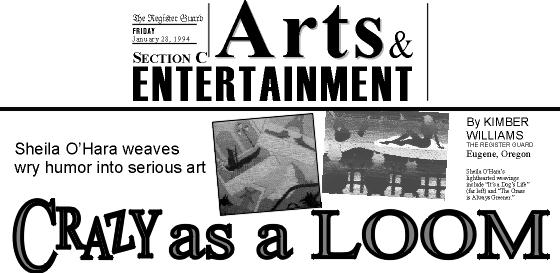
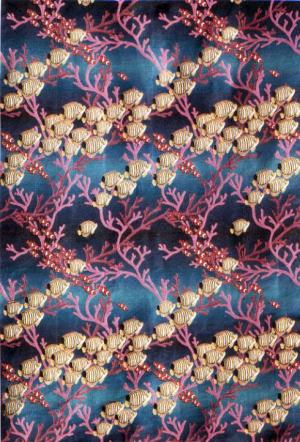
For O’Hara, everyday moments inspire. Like the time she and her husband were laughing at their German Shepherd, Heinrik, as the dog sat like an expectant tourist in the front seat of a rusted-out BMW. The moment became a snapshot. The snapshot resulted in a 3-foot-2-inch by 4-foot-2-inch weaving of scattered Polaroids depicting Heinrik as a world traveler: floating in a gondola through the streets of Venice, kissing a poodle by the Eiffel Tower, motoring past the Matterhorn. It’s not that O’Hara hasn’t tried to be serious about the business of weaving. Some of her pieces are curious and mystical; others, thought provoking. She let her wry humor slip briefly for a piece entitled “New World Order,” inspired by the Gulf War. An expression of the horror and frustration O’Hara felt during the 1991 Persian Gulf conflict, it depicts an audience sitting passively before curtains held back with yellow ribbons that frame a “Theater of War.” Before the audience, two snarling dogs of war tear at each other while trampling a mother and child. The air is filled with the haze of smoke from burning oil fields. “People don’t necessarily know what its about,” acknowledged O’Hara, during a recent telephone interview from her home in Oakland, Calif. “A New Hampshire newspaper reviewer said my weaving was clearly a comment on ecology, making special note of the ‘dueling coyotes,’” she laughed. This week, O’Hara and her work arrive in Eugene for a showing titled “Creativity and the Computer in Weaving,” at the Lane Community College Art Department Gallery. The exhibit also includes works by the textile artists Lia Cook and Cynthia Schira. The three women are among a half-dozen professional weavers who were invited to participate in the “Jacquard Project” – a German venture that merged art and industry by bringing together top textile artists from around the world with the latest computer technology in Jacquard weaving. Jacquard weaving is named for Joseph Marie Jacquard – a Frenchman who in the 1800’s invented the world's first machine to weave intricate patterns. His early punch-card technology was later instrumental in the development of computers. It took 200 years for the technology to come full circle, for computers to become an integral part of weaving technology. For O’Hara, it is just that. When she sits down to work at her loom, it is with a computer and keyboard mounted just above it – quite literally, a loom with a view, On a traditional loom, O’Hara is limited to using 16 pedals and four color combinations at once. A computer-assisted loom essentially replaces the old treadle system, giving her the equivalent of hundreds of treadles and an infinite range of colors and shapes. The computer doesn’t run the loom. O’Hara has to be there to wind the warp, put each thread through a heddle and manipulate the loom by hand. But the computer does interface with the loom, monitoring each color of thread and moving certain combinations of threads for her. It is still labor-intensive work. O’Hara may spend weeks perfecting a design and months weaving a tapestry, depending on its size. But critics praise the results: a complex twill system that derives its color from the warp (lengthwise threads) of the fabric rather than the weft (horizontal threads). “Her pieces are very distinctive,” said Barbara Setsu Pickett, associate professor of fiber arts in the University of Oregon Department of Fine and Applied Arts, which also uses computer-assisted looms. “She uses the loom to make arcs, circles, things that aren’t easy to do on a grid,” Pickett said. “She creates illusions of space in places where it doesn't exist.” O’Hara’s work is distinguished by its spectacular use of color, innovative designs and the artist’s wry sense of humor, Pickett said. “First of all, she’s a proficient colorist,” Pickett said. “The other aspect is her images are very personal – full of wit. Kind of daydreams, almost. A sense of play that is quite daring. “It always has this element of good fun. It's like reminding ourselves not to take ourselves too seriously,” she added. “You can be serious about art without being woeful, and she has that in her approach.” When it comes to indulging her own sense of humor, O’Hara feels she’s entitled. “How else can you get through this life?” O’Hara said. “Artists get too serious. I’m not up for that.” She’s been that route, attracting private and corporate commissions to create massive weavings for banks and businesses: AT&T, BankAmerica World Headquarters, Dean Witter, Lloyds Bank International. O’Hara jokes that the conservative, mainstream demands of corporate commissions ultimately drove her to quirkier work. “I was provoked into doing silly things,” she explained. Born in Japan and raised in San Francisco, O’Hara grew up as the youngest of seven children. She credits her mother for nurturing her artistic leanings. “We were always doing a million crafts projects,” O’Hara said. “In the summer, she would send us to the Josephine D. Randall Junior Museum of San Francisco, where I learned to weave placemats and ponchos.” But O’Hara stuck with it, continuing to weave in high school. She attended the California College of Arts and Crafts in Oakland, graduating in 1976 with a bachelor of fine arts degree, with distinction, in textiles. Despite her critical success, O’Hara laments the deep rift that remains between the realm of arts and crafts. Her finest work, she acknowledged, will never command the price of a comparable painting. “It is still the Great Wall of China,” she said. “I can remember when a big textile designer in New York tried to show my slides to the Metropolitan Museum of Art. They didn't want it in an exhibit of arts and crafts because it looked like a painting. They didn’t want it in fine arts because it was woven.” That attitude is changing – but slowly, said LCC weaving instructor Nancy Hoskins, who also uses computer-assisted looms. “I’ve been working in textile art for close to 30 years. When I started, there wasn’t, a gallery in the country that would have shown fiber art. It simply wouldn’t have dawned on them,” Hoskins said. “Now I’m just astonished at the number of shows and places that show fiber art – the growth in artists that I’ve seen. I think it is becoming valued.” “When you look back at the 20th century, I predict that we’re going to see the most exciting work done was in the fiber arts field – things that had never been tried before,” she said. Today, O’Hara’s fabric is part of textile collections in institutions that include the Smithsonian’s Cooper- Hewitt in New York, the Fine Arts Museum of San Francisco, and the Minneapolis Institute of Art. “I’m proud of what I’ve done, and I work hard,” O’Hara said. “But it’s really luck that you come up with good designs. It’s something that you almost have no control over.” © Register Guard, Eugene, Oregon 1994
|
 THEY’VE
BEEN DESCRIBED as daydreams, the quirky, complex images that world-class
textile artist Sheila O’Hara weaves first in her mind, then on her high-tech
loom.
THEY’VE
BEEN DESCRIBED as daydreams, the quirky, complex images that world-class
textile artist Sheila O’Hara weaves first in her mind, then on her high-tech
loom.